Monday, 31 July 2017

Further travels in Ecuador.


Ecuador to Peru

We find ourselves back in Ecuador after spending quite a bit of time early in May at Galapagos and the area north of the capital Quito.

This time we moved fairly quickly through the north of the country to focus on the south and the Ecuadorian Amazon. Ecuador, like Colombia, is heavily populated (compared to Australia that is) although it is covered to a greater extent in small agricultural holdings as the land is more fertile. Here the locals scratch out a living from the soil with the aid of oxen or the strength of their own backs. 

The climate at this time of year (June/July) is perfect, as it is for most of the year if you ask the expat community. Although on the equator most of inland Ecuador is at altitude so the weather is very pleasant. 
With a great climate, cheap cost of living, and the rent of a nice three bedroom country villa coming in at US$300/month, places like Vilcabamba in the south are popular. Americans on the pension could live very comfortably here, and they do. 

The regional tourist towns in Ecuador are less well presented than the equivalent in Colombia, but they are surrounded by wonderful mountain scenery. 
Some towns, like Banos however, in a stunning location in the Amazonian highlands, have been turned into what could be considered to be nature theme parks.
Situated in a naturally stunning deep river valley it has been turned into a bloody eyesore. There are zip lines everywhere, thermal baths, and grungy night spots litter the main street. Open sided buses, blaring loud tasteless local music (in my opinion), cart what must be brain dead Ecuadorians and others, from one man made eyesore to another.

Getting around is still painfully slow, and dangerous by Australian standards, so fewer Ecuadorians appear to own cars and the local buses are cheap, although this could also be due to economic factors.

With extended Overland travel in a vehicle comes roadside/camping ground/or carpark maintenance. I had to replace the clutch master cylinder on the dream machine whilst camped in a car park  by South Americas third highest waterfall the other day. I was bitching to myself about having to replace it again after what seemed only a couple of years. When I checked my service logbook it was actually in 2007 whilst returning from a trip to West Australia. When you hang on to a vehicle for twenty four years one loses track of time. It pays to keep a record!


Never let an opportunity to turn a natural feature like a cave into a religious icon pass you by in Ecuador. All those roses were fresh.


The cave entrance as seen from up the river.


The Otavalo market in the town of the same name in Ecuador. some great sights to be seen and some great local art.


 One of the locals killing some time after shopping for dinner, which is under her arm, and still           very active.


On the road to Cotopaxi volcano central Ecuador south of Quito.


How you can out run a volcanic eruption is beyond me.


Local artist signing an example of her work for Gael in the town of Tigua famous for it's primitive art style.


Stunning Ecuadorian scenery in the area of Tigua.
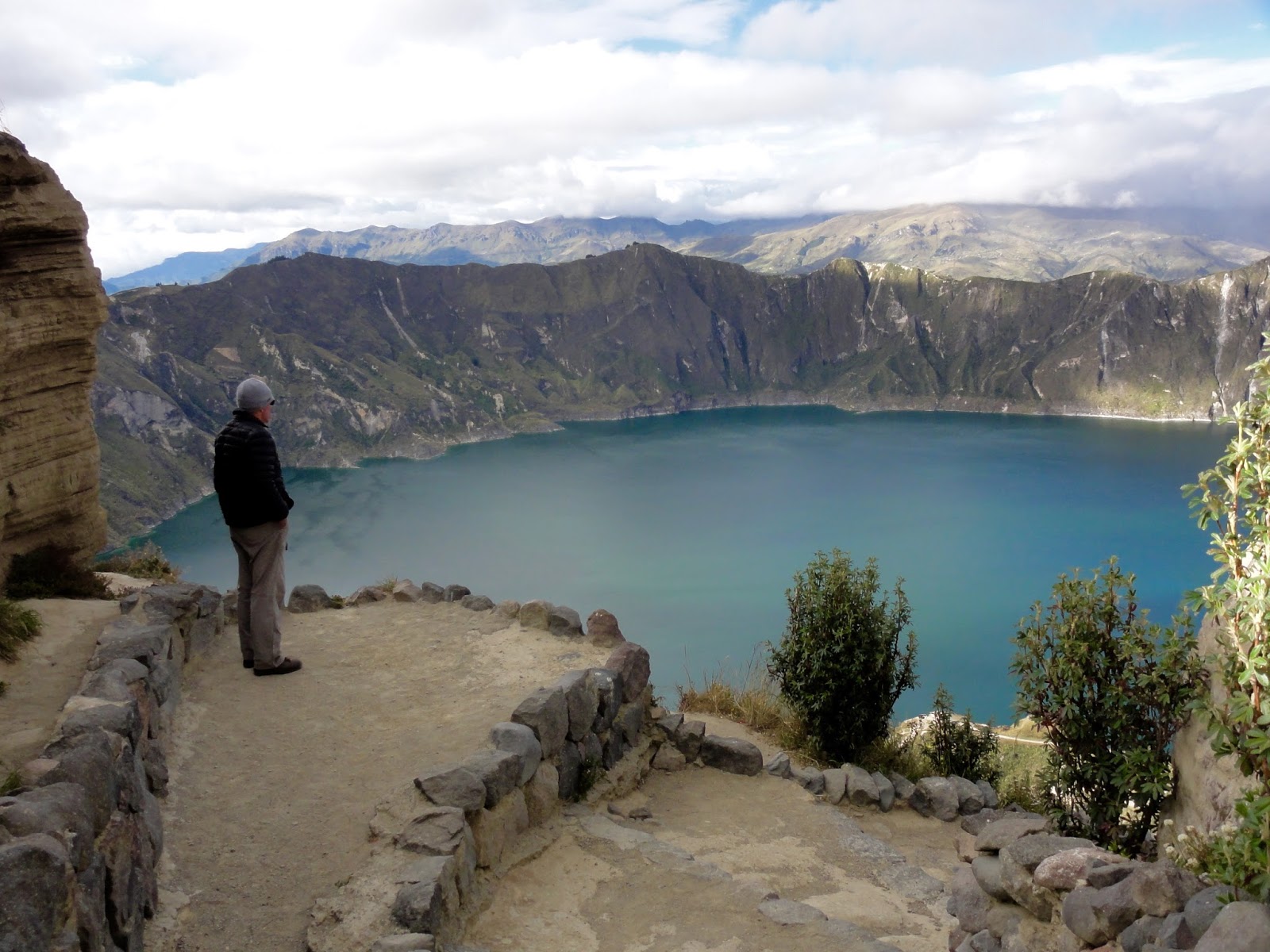


Looking into the crater lake at Laguna Quilotoa. It was freezing up here at night where we camped in the town square.


Our camp in the Ecuadorian Amazon .


At last a Macaw.

Gael armed with binoc's and camera she's not going to miss a thing.


A caiman lurking near our camp.

Thursday, 20 July 2017

Beautiful, green Colombia.


The need for a Brazilian Visa

Unfortunately we have to get a Brazilian visa to visit the Pantanal area of Brazil (just across the Bolivian border) when we get down that way in a month or two. Brazil is the only country in South America that requires a visa for entry, so for us it meant a visit to their embassy in Bogota.

We have been to Bogota on two previous occasions, only for short periods of time, but long enough to see the wonderful Gold Museum, and be convinced that I never wanted to drive there. 
Well, like it or not, this is exactly what we had to do. Gael did an admirable job of navigation but my interpretation of her fast flowing instructions did, at one point, give us the unique experience of driving on one section of the centre road reserve, bus only, transit lane.
Once on these bus transit lanes they are not easy to get off, however, stricken with panic, we managed to impress the local Bogotonians with our kerb climbing ability as we merged seamlessly with the bumper to bumper traffic in the parallel lane.

At the Brazilan Embassy the next day we received instructions in Spanish, from a not too interested admin officer, that we needed to fill out an online visa application, in Portuguese, we think, at a local internet cafe. After the first mind numbing hour I was in a hairs breadth of stepping outside the internet cafe and throwing myself under a bus when two twenty something girls on the computer next to ours offered their assistance. With the girls help, and that of another local young gentleman visiting the embassy, we got our paperwork submitted before closing time.

Initial advice was that it would take twelve days to expedite our visa application, but after discussions with the the vice consul, and explaining we were traveling differently to most applicants, we received an email two days later to say that the visas would be ready in only five days. Great service after Gael found a way to bypass the disinterested front of house staff.

We have zig zagged our way south through this stunningly picturesque country visiting as many points of interest as we can, including historic Colonial towns. 
Moving around Colombia is torture for the old truck though. Up and down 3,500 meters at a time over mountain ranges that run the length of the country. Crawling along behind lines of semi trailers moving at a snails pace over mountain passes and being held up by roadworks for several hours every day. Everything in this country moves by road, as the only rail transport company was liquidated in 1990.

We read a couple of days ago that in 2016 deforestation in Colombia increased by 44%. This probably goes some way to explaining why we have not seen any, not one example, of ground dwelling wild life. Every piece of this country, that can be, is cultivated. With around 45 Million hungry mouths to feed you need to grow a lot veggies.

However even with its few shortcomings Colombia comes highly recommended. 

On to Ecuador.........


I find several sharp blows to the forehead does wonders after a day at the wheel in South America.
Our 'camping' spot for the night in a 24 hour carpark. Secure and with shopping plaza next door.


El Penon at Guatape is a popular tourist town with an extensive lake system (hydro). In South America if you have a beautiful natural feature the obvious thing to do is to improve on it! In this case a stairway.


 Cheap local transport. I had to convince Gael not to ride on the roof.


Each dwelling has a themed relief art.


Again outside a pub!


Spent a few hours with Stuart who spotted our truck in Manizales. He is an Aussie who has sold up everything in WA to move to Colombia with dog Penny. At 55 he sees many happy years ahead of himself with his current (or a future) 30 year old Colombian girl friend.


Driving East/West across Colombia means crossing several mountain ranges. This is done at a snail like pace with heavy transport making the trip interesting. Brake maintenance or the lack of it sees many large rigs go arse up.


                                                 Beautiful, a member of the ginger family.


and again


Getting a bit of exercise in Salento. The area is in the coffee triangle and is a magnet for backpackers.


The jeeps were used to cart coffee beans at one stage and some may still do.They call them Willy's. But in the main they are used as taxis and provide a buzz for the tourists.


Following a jeep load of thrill seekers. I wonder how their travel insurance would view this risky transport if they fell off. 


Tourism is big in Salerno.


Wax palms grow to 60 metres high and grow for one hundred and twenty years. They are the tallest in the world I understand. Lucky for the local economy they weren't bowled over when the land was cleared  for grazing. 


Truly stunning country.


One of our campsites for a couple of nights near Salento. A twenty minute walk to the centre of town.


Local transport at the town of Los Lajas where the amazing church below is found.
Whilst walking through the gorge one night several hundred years ago apparently Rebecca's daughter Maria had a vision. This was enough to send the local priest into a frenzy of crowd funding.


                                                      Beautiful. Both of them!


Sunday, 25 June 2017

Colombia heading south.


What a bloody nightmare trying to get the Land Rover out of the Colombian Port at Cartagena. Some knob, in some department, decided to have our container randomly xrayed. 
For this little exercise we had to pay another US$450 in Port fees, just so they could see how many pairs of jocks I had in my top draw. What they thought two old farts like us would be trying to smuggle IN to Colombia is beyond me. 

After finally clearing the truck from customs we left steamy Cartegena and started meandering up the Caribbean Coast in the general direction of Venezuela. We found a wild camping spot for a tropical night (read, stinking hot) amongst the coastal scrub. What didn’t become apparent until after dark was that this particular part of the coast has possibly the worlds smallest and most vicious species of sandfly. 
You guest it! Gael was on the menu.

Traveling south towards the southern tip of South America one can take the coastal Pan American Hwy route, or as we will do, in the main, the inland route through the guts to Bucaramanga and on to Bogota, etc, etc. A good proportion of this road passes through small communities. Preceding and following each community are the mandatory speed humps where you are forced to slow, or suffer a concussive blow as your head strikes the cab roof. Locals try to sell refreshments as you slow to wipe the blood from your forehead.
These unique small towns are slowly being bypassed with dual carriageway, and whilst the constant head banging can be annoying, the journey as an experience will be diminished, and many livelyhoods that depend on the passing traffic will be lost, as the road works continue.

Having spent a fair bit of time driving in different countries by now, and as a consequence observing driving styles around the world, I can at this point in time safely say that Colombian drivers are in a class of their own. The road toll here must be staggering. 
The only thing that scares me more than a day behind the wheel is the possibility of a second term of Donald Trump, or the thought of being a passenger on a commuter tour coach as it overtakes a semi trailer, going up hill, across double lines, on a blind hairpin bend. 
Perhaps the new dual carriage ways are a good idea! 

Colombia is very pleasant. The colour green is dominant as the country side is lush, and in the deep valleys between the massive mountain ranges the weather is very tropical. 

The people are generally warm and welcoming and we are often approached with an outstretched hand. Thereafter follows a faltering explanation in Anglospanish, incorporating over exaggerated hand signals, of how the vehicle got here, and our reason for being in the country. Gringos are still very much an oddity here, particularly driving a RHD Landrover Camper from Australia. 


Cartagena old walled city.

Street after street of great old colonial houses.

Still exploring old city waiting for the truck to be released by customs.

View from our apartment in Boca Grande, Cartagena. Our Hilton camp (shown below) is at the end  of the peninsula behind the Hilton.

Our first free beach camp after picking up the truck in front of the Cartagena Hilton. Whilst the guests at the Hilton played tennis and grunted at their exertions, we got some rest in the camper. A couple of locals even less fortunate than us slept on cardboard under the shelter for the night.


Tayrona NP on Caribbean coast is hot and humid. A French couple at the end of their South American adventure shared the campsite prior to shipping their vehicle back to Europe. The couple (he about our age and she a little younger) spent the entire trip of six months sleeping in the back of their mid sized Toyota.

At last a Blue Macaw, even if it was tame, was still a thrill. The young girl, her parents and older sister, from Bulgaria have been traveling through North, Central and now South America for several years in their camper. The parents Peter and Lucy do their home schooling on the road. What an education!

San Gil camp by the river. Reasonably quiet given there were no barking dogs for a change. The road was a little to close so we slept with the roof down anyway.


Camp at Paragliding site overlooking Bucaramanga.


This campsite a little south of Bucaramanga was on the edge of the most stunning Canyon del Chioamococha (try saying that with a mouth full of marbles).
Only cold showers, but no road noise, and they locked their dogs up at night. Yes, yes, yes, peace and bloody quiet.


Didn't see any of these. 

Loading sugar cane for the mill Colombian style.

Villa de Leyva old colonial town in the cool highlands. A real tourist town and we happened to be there on a long weekend. Great places to eat at reasonable prices. All the Bogota high flyers flock to the place. 

Great colourful pottery wish we could take some home. More Mexican than Colombian though I think.

Incredibly fine beaded hummingbird necklace. All the Colombian art we have seen here is mind-blowing as well. Just a shame we don't have the room to take some home! Could happily fill the house with it.

The whole town has wonderful colonial style buildings. This one has had a full reno, but the whole town was very neat and tidy with all the buildings following a similar architectural style. 

Tempting but we didn't eat here.

Our Villa de Leyva camp ground was not bad. Toilets with seats, hot water for the showers for a change, and mainly family camping clients. The barking dogs were a pain in the neck again though. On dusk the bloody things start up and take most of the night to settle down. So down with the roof again, and on with my newest continuous looping iTunes tape of a gently flowing mountain stream. What a bloody great idea for a "dog noise pollution solution".